
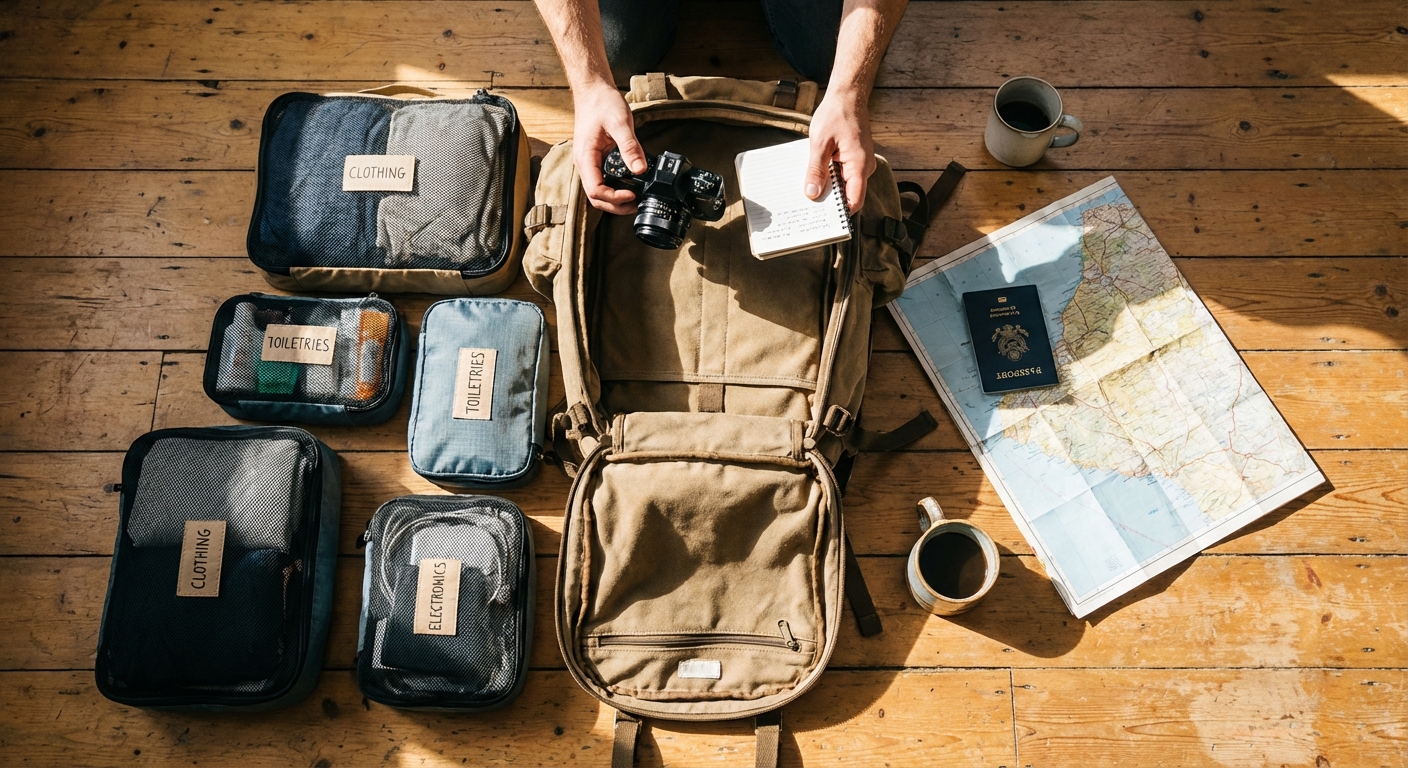
The difference between a chaotic trip and an effortless adventure often comes down to one thing: how you pack. You can either wrestle an overstuffed suitcase through subway turnstiles, or glide off a plane with a single, dialed-in bag and a grin.
Packing Is a Skill—And It Can Set You Free
This step-by-step blueprint will teach you how to pack like a pro explorer—with gear that’s light, functional, and ready for whatever the road throws at you.
Step 1: Start With the Journey, Not the Gear
Before you even touch your closet, answer three questions:
Where are you going?
- Mountains, tropics, desert, cities—or a mix?
What will you do most?
- Hiking, diving, city wandering, road-tripping, festival-hopping?
How long will you be gone?
- Weekend, two weeks, months?
Use these answers to guide your packing priorities. For example:
- Iceland road trip: windproof and waterproof above all.
- Bali + Komodo islands: sun protection, swim gear, light fabrics.
- Alps hut-to-hut trek: serious footwear, layering system, compact sleeping liner.
Step 2: Choose Your Base Carry—Backpack, Duffel, or Roller
Travel Backpack
- Best for: Mixed city and trail travel, frequent moves, public transport.
- Look for: 30–40L, front-loading, padded hip belt, water-resistant fabric.
Duffel Bag (With or Without Straps)
- Best for: Road trips, single-base adventures, adventure tours.
- Bonus: Handles odd-shaped gear (climbing gear, ski boots) easily.
Carry-On Roller
- Best for: City breaks, smooth itineraries, work trips.
Pro Explorer Move:
For adventure-heavy trips, go travel backpack + packable daypack. For road trips or fixed-base adventures (like a surf camp or ski chalet), a duffel + small daypack is incredibly practical.
Step 3: Build Your Adventure Wardrobe in Layers
Think in systems, not outfits. This keeps you agile whether you’re wandering markets in Oaxaca or climbing above the clouds in the Dolomites.
The 3-Layer System
- Base Layer – Touches your skin.
- Choose quick-dry or merino tops and underwear.
- Mid Layer – Adds insulation.
- Lightweight fleece or synthetic puffy jacket.
- Outer Layer – Shields you from wind and rain.
- Compact, seam-taped rain shell.
Sample Clothing Blueprint (7–14 Days)
- 2 quick-drying T‑shirts
- 1 long-sleeve base top
- 1 nicer shirt/top for evenings
- 2 pairs of pants/shorts (at least one with some stretch)
- 1 lightweight fleece or puffy
- 1 rain jacket
- 3–4 underwear, 3 socks
- 1 swimsuit
- 1 sleepwear set
Adjust fabrics and warmth according to your destination.
Step 4: Dial in Your Footwear
You’ll walk more on the road than at home—often 15,000+ steps a day—so your shoes matter.
Two-Pair Formula
- Primary pair: Trail runners or light hiking shoes.
- Secondary pair: Sandals or compact slip-ons.
For trips like Peru’s Sacred Valley, Norway’s fjords, or New Zealand’s South Island, trail shoes hit the sweet spot between city comfort and mountain grip.
Tip: Wear your bulkiest shoes on travel days to save pack space and weight.
Step 5: Organize With a Simple Packing System
Stay organized so you can pack and unpack in minutes, not hours.
Gear You’ll Need
- 2–3 packing cubes (tops, bottoms, underwear/socks)
- 1 tech pouch (chargers, adapters, cables)
- 1 small dry bag (wet clothes, river trips, valuables in heavy rain)
Packing Strategy
- Load the heaviest items (shoes, electronics) against your back.
- Fill gaps with packing cubes.
- Keep toiletries and rain jacket near the top.
- Stash passport and cash in an internal zip pocket or money belt.
This setup lets you transform chaos into order in any hostel, hut, or guesthouse in under 5 minutes.
Step 6: Choose Tech That Serves the Journey
More devices = more weight, more chargers, more stress.
Core Tech Setup
- Unlocked smartphone
- Power bank (10,000–20,000 mAh)
- Universal adapter (with USB-C ports)
- Noise-isolating earbuds
Optional (depending on your style):
- Compact camera with a prime lens if you’re serious about photography.
- Lightweight laptop or tablet if you work remotely or write extensively.
Download offline maps for every destination (city and trail) before you leave—especially useful in the Dolomites, Scottish Highlands, or remote islands.
Step 7: Assemble a Minimal but Mighty Toiletry Kit
Skip the full-size bottles. Your goal is compact and refillable.
Toiletry Essentials
- Toothbrush, small toothpaste, floss
- Refillable 50–100 ml bottles of shampoo/body wash
- Deodorant
- Razor (if needed)
- Solid bar soap or 2-in-1 products to reduce liquids.
Micro First-Aid and Health
- Blister plasters or moleskin
- Pain relief tablets
- Antiseptic wipes
- Any personal medication + copies of prescriptions
Buy items like sunscreen and bug spray at your destination if they’re cheaper and widely available (common in Southeast Asia and Latin America).
Step 8: Customize for Your Adventure Style
Now fine-tune based on your actual destinations.
Mountain & Trekking Adventures
Ideal for: Swiss Alps, Rockies, Patagonia, Himalaya.
Add:
- Trekking poles (collapsible)
- Sleeping bag liner
- Buff/headwear, gloves, beanie
- Headlamp
Coastal & Island Escapes
Ideal for: Greek Islands, Philippines, Caribbean.
Add:
- Reef-safe sunscreen
- Sarong or light wrap (beach + cultural sites)
- Dry bag for boat trips and beach days
- Mask/snorkel (optional; can often rent locally)
Urban Exploration & Rail Journeys
Ideal for: Japan, Western Europe, city-hopping trips.
Add:
- Compact day sling or crossbody bag
- Travel journal or Kindle
- Small combination lock for hostel lockers
Sample Pro Explorer Packing List (Carry-On Only)
- 35–40L travel backpack
- Packable daypack
- 2 technical T‑shirts, 1 long-sleeve, 1 casual shirt
- 2 pants/shorts
- Fleece or light puffy
- Rain jacket
- 3–4 underwear, 3 socks
- Swimwear, sleepwear
- Trail shoes + sandals
- Packing cubes (3), tech pouch, dry bag
- Phone, power bank, universal adapter, earbuds
- Minimal toiletry kit + mini first-aid
- Buff, cap, sunglasses, travel towel
With this setup, you can board a plane to almost anywhere—Chiang Mai, Cusco, Chamonix, Cape Town—and be ready for both city streets and side trails.
Step 9: Do a Test Pack (And Trim 10–15%)
Lay everything out. Pack your bag. Then:
- Remove 1–2 clothing items you “like” but don’t need.
- Ditch duplicate gadgets.
- Confirm you can lift your bag one-handed and walk with it comfortably.
If it feels a little empty, that’s perfect—you want extra space for that handmade textile in Oaxaca or the unexpected jacket you score in a Tokyo thrift shop.
Your Gear Is Ready. The World Is Waiting.
Once you’ve built this kind of travel gear system, planning the next adventure becomes addictively easy. New destination? Just tweak a few items and go.
Stop overpacking. Start over-preparing—smartly, lightly, and with enough room in your bag (and your schedule) for the detours that turn trips into stories.
Zip it up. Book the ticket. The rest, your gear—and your grit—can handle.