
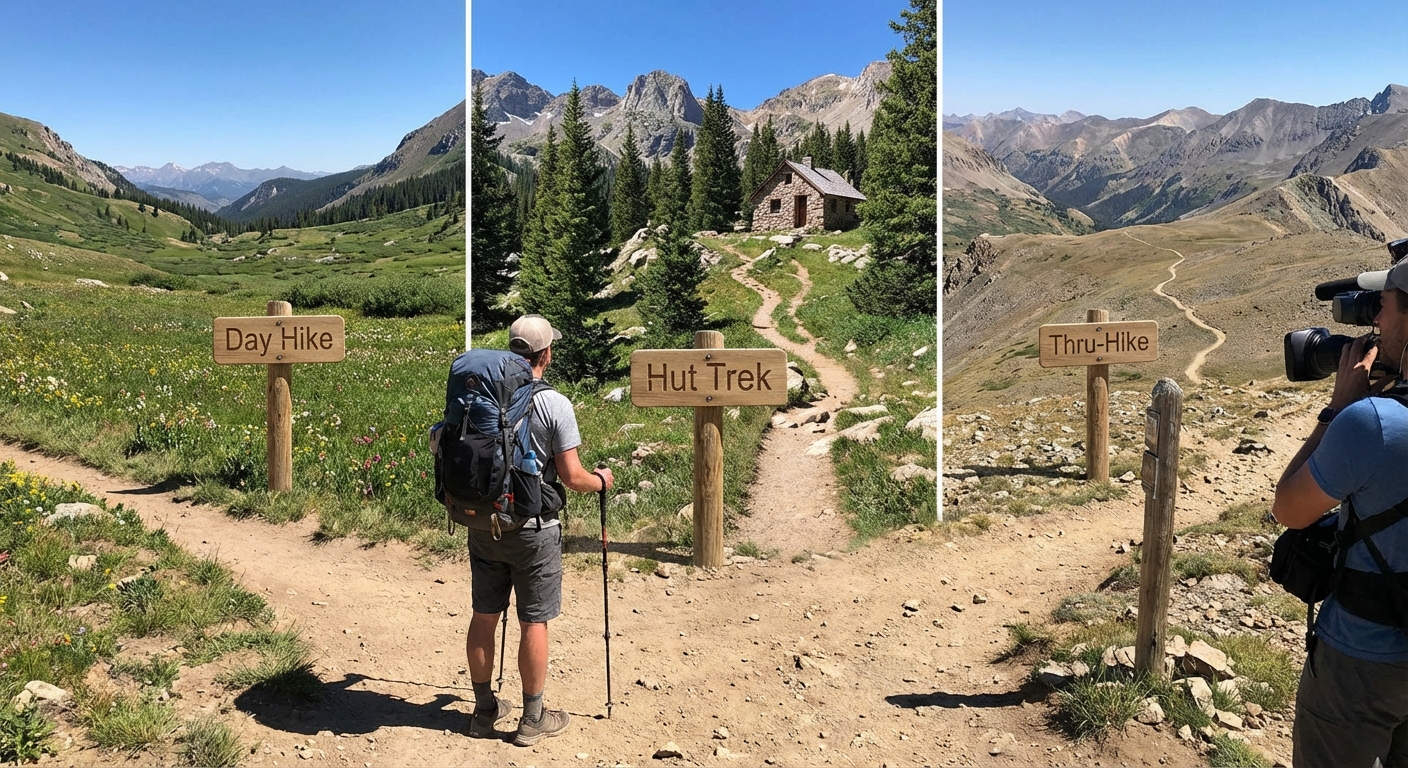
You know you want mountains, forests, and a heavy dose of sky—but what type of trail matches your time, budget, and appetite for challenge? Hiking comes in many flavors, from mellow day hikes to full-on thru-hikes that reshape your year.
Not All Hiking Trails Are Created Equal
This guide compares three major styles of hiking—day hikes, hut‑to‑hut treks, and wild thru‑hikes—so you can choose the right kind of adventure for your next trip.
1. Day Hikes: High Impact, Low Commitment
Best for: Tight schedules, beginners, families, and travelers using one town as a base.
Day hikes are out-and-back or loop trails you complete in one day. Think sunrise climbs, waterfall loops, and short summit pushes.
Why You’ll Love Them
- No heavy overnight gear
- Simple logistics—sleep in the same bed every night
- Easy to link with city breaks or road trips
Destination Highlights
- Cinque Terre, Italy: Coastal paths connecting colorful villages.
- Banff & Jasper, Canada: Lakeside and alpine day hikes from town bases.
- Madeira, Portugal: Levadas (irrigation-channel paths) with wild cliffs and lush valleys.
Budget Snapshot
- Accommodation: choose one budget-friendly base (hostel, guesthouse, or campground).
- Transport: local buses, shuttles, or rental car.
- Food: market breakfasts, trail snacks, and one hot meal per day.
Essentials to Pack
- 15–25 L daypack
- 1–2 L water + purification tablets
- Snacks/lunch
- Lightweight rain jacket and fleece
- Small first aid kit and headlamp
Insider tip: For popular national parks, research timed-entry systems or shuttle reservations weeks in advance to avoid being turned back at the gate.
2. Hut‑to‑Hut Treks: Wilderness by Day, Comfort by Night
Best for: Travelers ready to step beyond day hikes without committing to heavy backpacks and full self-sufficiency.
Hut treks link mountain refuges, lodges, or tea houses, so you can hike all day and sleep in a bed with a roof and (sometimes) a hot meal.
Why You’ll Love Them
- Carry less: no tent, light sleeping gear, limited food
- Social: meet hikers from around the world over shared dinners
- Safer: fixed shelter and often staff who know local conditions
Iconic Hut Treks
- Tour du Mont Blanc (France–Italy–Switzerland): Alpine villages, glaciers, and classic refuges.
- Alta Via 1, Dolomites, Italy: Jagged limestone peaks and cozy rifugi with excellent food.
- New Zealand Great Walks (e.g., Routeburn, Kepler): Well-maintained huts in spectacular landscapes.
Budget Snapshot
- Huts/refuges: $40–$90 per night (often including dinner and breakfast)
- Daily total with snacks and drinks: $70–$150, depending on region
- Transport: moderate—trailheads are usually reachable by public transit
Packing List Highlights
- 35–50 L backpack
- Lightweight sleeping bag liner (huts often supply blankets)
- Minimal clothing (2–3 outfits on rotation)
- Earplugs and eye mask (dorm rooms!)
- Cash—many huts don’t accept cards
Insider tip: Book the most popular huts well in advance, but keep one “flex” day in your itinerary to ride out bad weather.
3. Wild Thru‑Hikes: Life on the Trail
Best for: Experienced hikers and long-term travelers ready for a mental and physical reset.
Thru-hikes are long-distance trails you walk in one go, often for weeks or months, carrying most of what you need.
Why You’ll Love Them
- Immersion: you live entirely within the rhythm of the trail
- Transformation: your fitness, confidence, and perspective evolve dramatically
- Simplicity: each day boils down to walking, eating, and sleeping
Legendary Thru‑Hike Options
- Pacific Crest Trail (PCT), USA: Mexico to Canada along the western mountains (~4265 km).
- Appalachian Trail (AT), USA: Georgia to Maine through forests and ridges (~3500 km).
- Te Araroa, New Zealand: Cape Reinga to Bluff, beaches to alpine passes (~3000 km).
- Via Alpina segments, Europe: Multi-country Alpine network you can customize.
Budget Snapshot
- Thru-hikers on major trails often estimate $1000–$1500 per month, including town stops, gear replacement, and permits.
- You can trim this with more camping and fewer restaurant splurges, but it adds up over time.
Essential Gear Differences
- 50–65 L ultralight or light backpack
- Reliable tent, sleeping bag, and pad for a range of conditions
- Stove and cookware
- Detailed maps/GPX and guidebooks or apps
- Systems for resupplying food every 3–7 days
Insider tip: Test your entire gear setup on a 3–5 day shakedown hike before committing to months on trail. Problems multiply over distance.
Side‑by‑Side Comparison
| Feature | Day Hike | Hut Trek | Thru‑Hike |
|---|---|---|---|
| Typical duration | Hours | 3–12 days | Weeks to months |
| Pack weight | Lightest | Moderate | Heaviest (but often ultralight gear) |
| Comfort level | High (sleep in town) | Medium–high (beds, hot food) | Variable (mostly camping/shelters) |
| Planning complexity | Low | Medium | High |
| Average daily cost | Low–medium | Medium–high | Medium (but over long duration) |
| Best for | Beginners, casual travelers | Intermediate hikers, social types | Experienced, adventure-obsessed |
How to Choose the Right Style for Your Next Trip
Ask yourself a few honest questions:
Time: How many consecutive days can you realistically take off?
Fitness: Can you comfortably walk 15–25 km (9–15 mi) multiple days in a row?
Comfort: How do you feel about dorms, tents, and minimal showers?
Budget: Is your total trip budget closer to $500 or $5000?
Goal: Do you want a taste of adventure, a solid challenge, or a complete reset?
Then match your answers:
- Choose day hikes if you want flexibility, easier logistics, and scenic hits between other travel plans.
- Choose a hut trek if you’re ready to push into multi-day terrain, meet other hikers, and keep packs moderate.
- Choose a thru-hike segment (you don’t have to do the whole thing!) if you want a transformative experience without quitting your life for months.
Budget Tips by Style
- Day hikes:
- Base yourself in smaller towns just outside major tourist hubs.
- Use public transit to reach trailheads where possible.
- Hut treks:
- Book half-board; buying food separately at altitude is often pricier.
- Bring your own lunch supplies from valley supermarkets.
- Thru-hikes:
- Buy food in bulk in larger towns.
- Cook most meals, limit town nights, and split rooms with other hikers.
Realistic Starter Paths
- New to hiking?
- Start with day hikes plus one single overnight at a nearby campground or hut.
- Comfortable with overnights and want more?
- Try a 5–7 day hut or camping trek like the Laugavegur in Iceland or West Highland Way in Scotland.
- Already love multi-day trips?
- Pick a 10–14 day segment of a major thru-hike (like a section of the PCT or Camino routes) to test the waters.
Turn Your Preference into a Plan
Open your calendar and mark:
- How many days you can travel
- A realistic budget
- The style that excites you most from this guide
From there, search one or two candidate trails that match your answers. Sketch a simple packing list, estimate costs, and commit to dates.
You don’t have to leap straight into a 3,000 km odyssey. The right trail style is the one that stretches you just enough to feel alive—without snapping your schedule or your budget.
Pick your format, shoulder your pack, and let the trail do the rest.